Класс Месторождения: Среднее
Тип Месторождения: Нефтяное
Местоположение: Море
Местность:
Стадия разработки: Доразведка
Год открытия: 2012
Источник информации:
Метод открытия: Сейсмика
Площадь: 36.94 км²
The Paon field is a significant deepwater oil discovery in the Tano Basin, offshore Côte d'Ivoire. First discovered in June 2012 by Tullow Oil with the Paon-1X well
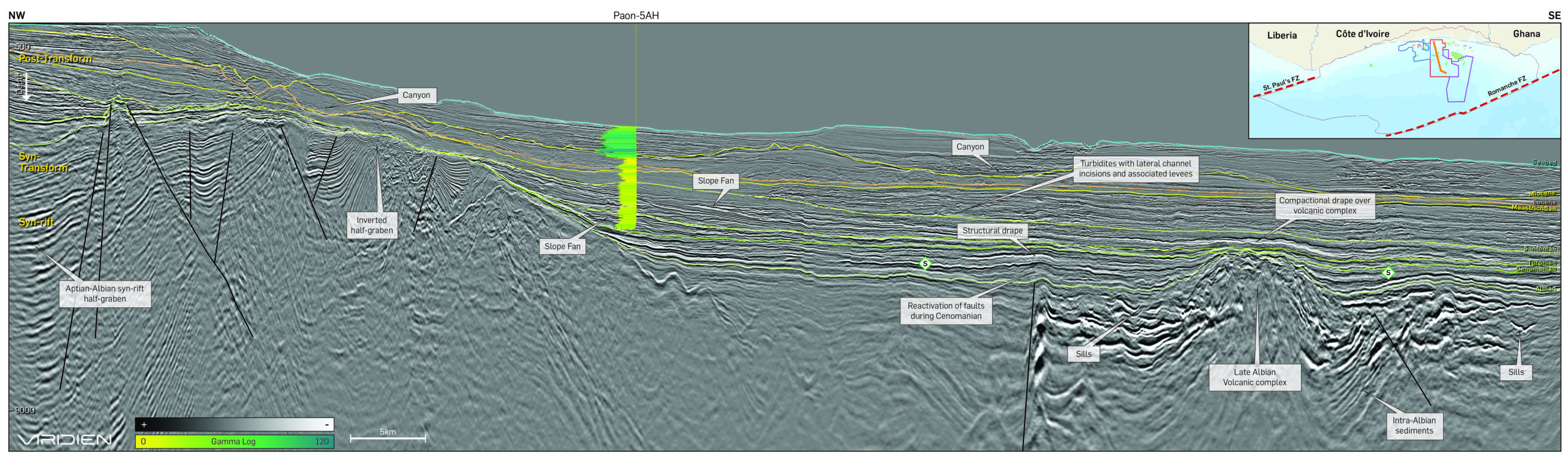
Its geology is characterized by a complex "play" typical of the West African Transform Margin.
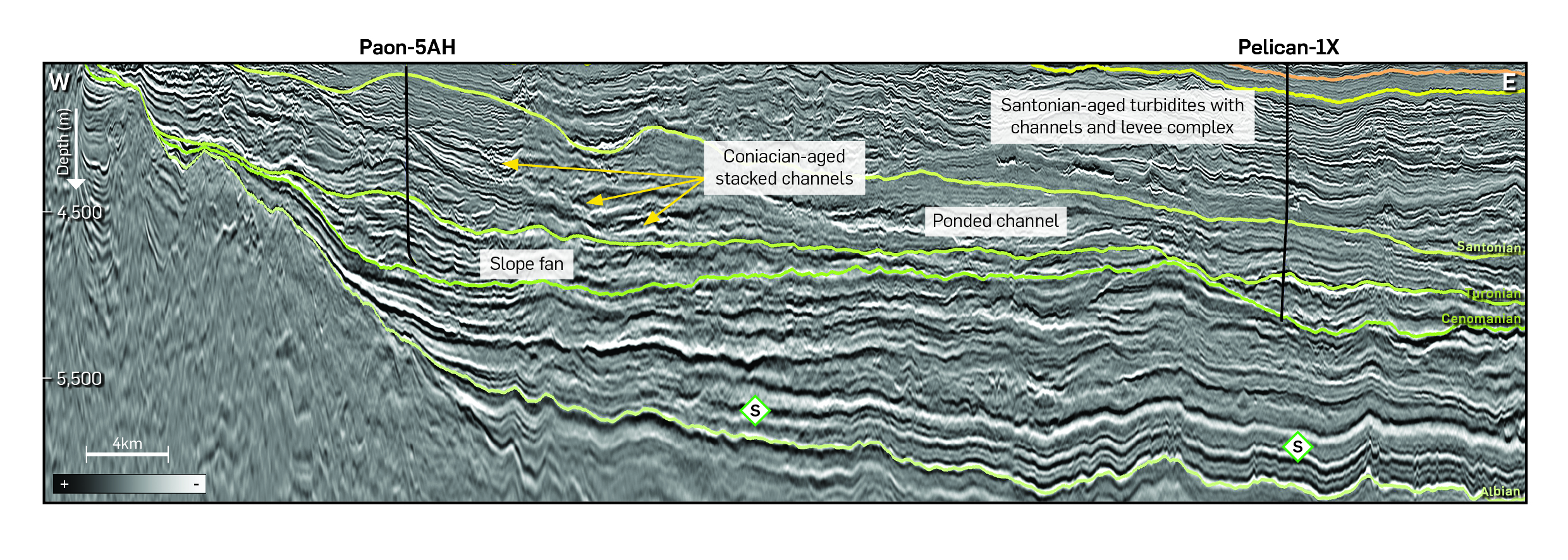
Stratigraphy & Reservoir Age: The primary reservoirs are Upper Cretaceous (specifically Late Cretaceous) in age.
Lithology: The reservoir consists of turbidite sands deposited in deep marine environments.
Depositional System: These sands form part of extensive turbidite channel and fan complexes.
Net Pay: The discovery well (Paon-1X) encountered 31 meters of net oil pay within a gross interval of 74 meters of turbidite sands.
Trap Mechanism Type: Paon is primarily a stratigraphic trap or a combination structural-stratigraphic trap. Hydrocarbons are trapped as reservoir sands pinch out or shale-out against underlying syn-rift structural highs. This is a "play-opening" concept for the region, similar to the world-class Jubilee Field in neighboring Ghana.
Petroleum System Source Rocks: The oil is believed to be sourced from organic-rich Albian, Cenomanian, and Turonian shales. The field contains light oil (approximately 41° API) with a continuous hydrocarbon column confirmed by pressure data.
Tectonic Setting: The field lies within a wrench-shaped basin formed during the separation of Africa and South America (Albian age), characterized by strike-slip and transform faulting.
Murphy Oil is currently conducting a commerciality review and evaluating field development concepts. The field is part of a broader push by Côte d'Ivoire to triple its oil production by 2027, alongside major projects like Eni’s Baleine and Calao fields.
Следующее Месторождение: 047/02-G-001